
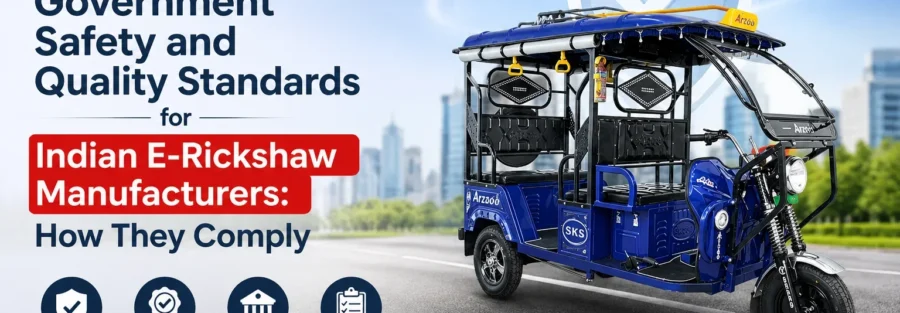
Quick Facts:
-
- Electric Rickshaw Manufacturers in India Must Comply With the Central Motor Vehicles Rules (CMVR) Set By the Government of India.
-
- Manufacturers Also Require Type Approval Certification for Each E-Rickshaw Model From Authorized Testing Agencies Including ICAT and ARAI.
-
- It Is Mandatory To Follow Automotive Industry Standards (AIS) For Vehicle Design, Electrical Systems, Brake System, and Passenger Safety.
-
- All Batteries and Battery Systems Used in E-Rickshaws Must Meet Bureau of Indian Standards (BIS) to Fulfil Safety Requirements.
-
- Manufacturers Must Also Maintain Vehicle Quality Testing and Inspection Records For Regulatory Verification.
-
- E Rickshaw Manufacturers Seeking Government Subsidies and Incentives Must Comply With FAME India Scheme
Introduction
Indian E Rickshaw Industry is backed by government authorities considering it as an eco-friendly and sustainable mode of transport. Indian government is also encouraging auto rickshaw drivers to switch to E-Rickshaw by running incentive programs and offering subsidies. This has given rise to the use of E-Rickshaws with several Electric Rickshaw manufacturers joining the market.
But considering vehicle and road safety rules, the Government of India has made it mandatory to get a few certifications and adhere to a few quality and safety standards. Manufacturers who wish to grow their electric vehicle business are strictly following these protocols and regulations. Let’s understand these certifications and testing norms through this blog.
Audit of Manufacturing Facilities by Trusted Agencies
Continuous increase in electric rickshaw manufacturing units is rising a concern towards the use of counterfeit and unverified products. To control it, government has made it mandatory to conduct audit of the manufacturing and production units, which includes:
-
- Type Approval – Each vehicle model will undergo testing by reputed organizations including ICAT or ARAI.
-
- Quality Control – It has become mandatory to follow strict quality control mechanisms that match certified vehicle prototypes.
Conformity of Production (CoP)
Complying with CoP norms has become mandatory for both small and large scale manufacturers. It ensures that each E Rickshaw model rolled out of assembly line meets the quality and safety standards of the originally tested prototype. If manufacturers fail to conduct these tests or match these expectations, it affects the validity of their vehicle’s fitness certificate.
MoRTH and AIS Norms Compliance
The Ministry of Road Transport and Highways (MoRTH) and Automotive Industry Standards have set proper guidelines for designing electric rickshaws. Electric rickshaw manufacturers are advised to adhere to each guideline strictly. These guidelines include:
-
- Speed limit of each electric rickshaw is hard capped at 25km/h.
-
- Manufacturers must only choose lithium-ion batteries for e-vehicles.
-
- All electrical components must be sealed within a waterproof enclosure to prevent short circuits.
-
- Every E-Rickshaw must pass structural integrity requirements.
BIS Certifications for Components
Every manufacturer is advised to source and utilize BIS (Bureau of Indian Standards) certified components including tyres and tubes. The components must have ISI mark on them. Electrical and charging related components must follow safety rules and guidelines stated under BIS and AIS guidelines.
Conclusion
From meeting ICAT and ARAI testing standards to complying with CoP, MoRTH, AIS, and BIS compliances, electric rickshaw manufacturers are strictly advised to adhere to norms and regulations formed by the Government of India. In today’s competitive world, only those manufacturers who successfully pass these quality and safety requirements. At Arzoo E Vehicles, we fulfill all these government-stated protocols to ensure that we supply quality-tested, well-designed, and safe electric vehicles for Indian roads.
FAQs
Manufacturers are required to get certified ICAT or ARAI along with adhering to regulations set by CMVR.
CoP ensures that every vehicle designed and manufactured meets the quality and safety standards of the original and approved prototype.
Yes, manufacturers are strictly advised to use only BIS certified components, be it battery, charging systems, tyres, and tubes.
According to MoRTH, (Ministry of Road Transport and Highways), electric rickshaws are capped at a maximum speed of 25km/hr.
Manufacturers who non-comply with the safety standards set by MoRTH, CoP, ICAT, and AIS face problem in vehicle certification, vehicle fitness approval, and government subsidies.